
Zscaler's AI Security Partnerships Follow a 3% Workforce Cut Plan
On this page 6 sections
AI-generated editorial illustration.
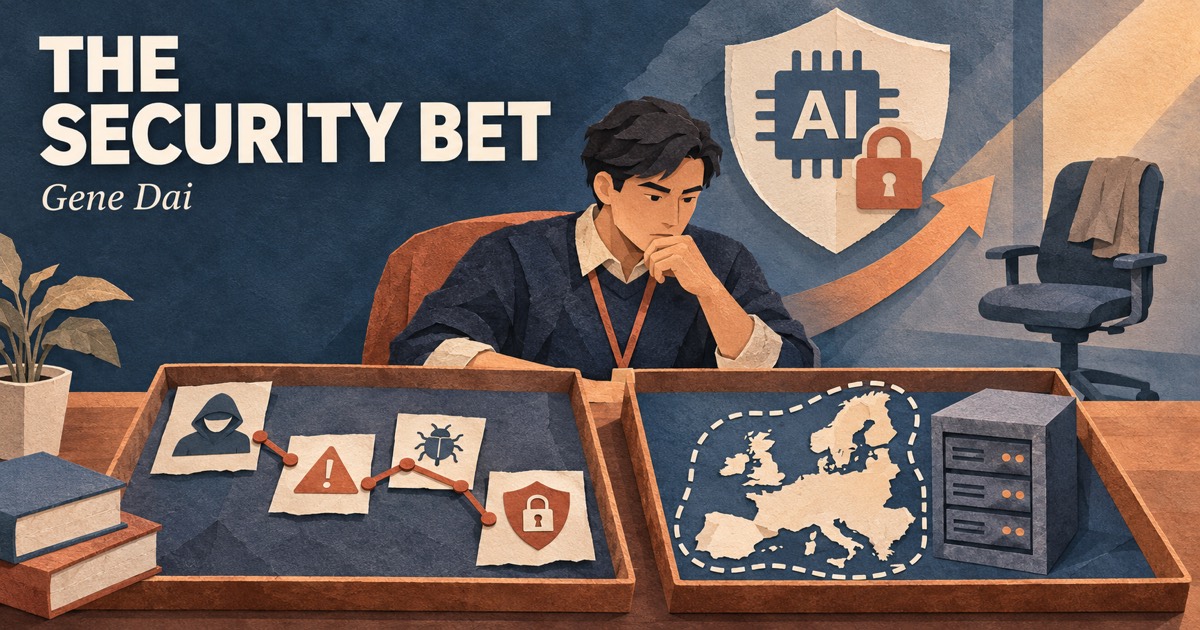
On November 20, Zscaler announced two collaborations with frontier-model companies. One involves Anthropic’s cyber program and a planned limited preview of a vulnerability-analysis feature using Claude Mythos 5.1. The other pairs Zscaler’s European security platform with Mistral. The announcement puts the two under a single AI-security story. An enterprise buyer would have to evaluate them separately: one is about finding and explaining attack paths, the other about securing AI adoption under European data and operating constraints.
The second document is a September 3 securities filing. Zscaler had committed to reducing its worldwide headcount by approximately 3%. It expected $30 million to $33 million in one-time charges, mostly severance and benefits, with most of the charge recognized in the first half of fiscal 2027. The company said the plan would reallocate resources to support AI and growth initiatives. It did not disclose the affected functions, a post-cut organization chart, or an amount earmarked for either model collaboration.
The November release cannot show that the September reduction paid for these products or that AI replaced the people who left. It puts three decisions on different clocks: a workforce plan already approved, a security feature awaiting preview and a regional integration whose customer results are undisclosed. Zscaler has a growing business and two technical bets. The evidence for each will arrive at a different time.
Two model partnerships, two different jobs
The Anthropic work begins inside the security team’s own workflow. Zscaler says it is using Anthropic’s Cyber Verification Program to advance vulnerability discovery and research. It separately says it has integrated Claude Mythos 5.1 into Endpoint AI Security to power Exploit Paths. The described feature correlates evidence across an attack sequence, identifies potential threats and shows defenders where they could break the chain. Zscaler says a limited preview is planned. That last phrase matters. A planned preview is not a generally available customer product, and the release supplies no customer outcome, accuracy result or price.
The Mistral connection addresses a different buyer. Zscaler says its Security for AI solution, delivered through a sovereign European Zero Trust Exchange, integrates with Mistral to help European enterprises adopt AI while meeting security, data-protection and sovereignty requirements. The announcement does not say which customers are using the integration, what models or workloads are in scope, or how regional processing is enforced across every part of the combined service. Mistral’s own August announcement says its regional endpoints let customers choose Europe or the United States for inference, subject to limited safeguarded transfers to subprocessors outside the selected region. A buyer cannot replace that qualification with the word “sovereign.”
The two propositions share a sales umbrella but fail in different ways. A false Exploit Path can send analysts toward the wrong fix or create a pile of findings that nobody verifies. An enterprise using Mistral behind a security boundary has to examine data route, identity, permissions and service continuity. A security team might need both capabilities. One demo cannot establish both.
A frontier-model name compresses several handoffs into one line of a release. A model can help infer a likely attack chain from scattered evidence; it still needs current telemetry, known asset relationships, reproducible findings and a person empowered to change a production system. A regional model endpoint can keep inference in a selected geography while a separate logging, support or subprocessor path has its own terms. Zscaler’s announcement gives buyers a direction and an integration. It does not map every data flow.
Anthropic’s access policy illustrates the work that comes after model selection. Its October program defines Defense, Red Team and Specialized access with different verification conditions. In Anthropic’s own evaluation, 46 of 50 attempted cyber tasks in the Defense tier were blocked somewhere, while 34 of 50 completed in the Red Team tier with no blocks. Those results describe Anthropic’s safeguard test, not Exploit Paths performance. They show why security teams must decide who is allowed to run what kind of analysis, under which authorization, with what record of the result. A vendor partnership cannot make those choices for the customer.
There is a supplier constraint here, too. Anthropic says cyber capabilities are dual use: a model that helps a defender find a vulnerability can help an attacker exploit one. Its access tiers are an attempt to give verified professionals more capability while retaining limits for other users. Zscaler’s partnership does not remove that tension. A product team must design around refusals, changed model behavior and the possibility that an emergency investigation needs a capability outside its approved tier. The public Zscaler release does not say how Exploit Paths handles those cases. A customer trial should include a blocked but legitimate task and a model-unavailable interval, not only a clean success path.
The September decision on people and money
The headcount disclosure was unusually explicit about purpose. Zscaler’s filing said the planned approximately 3% reduction would strategically reallocate resources for AI and growth. It estimated $30 million to $33 million of nonrecurring charges. It did not state a savings target, number of employees, future hiring plan or affected teams. The annual report says the company had more than 8,700 employees on July 31. That earlier, rounded denominator suggests an order of magnitude but cannot turn a September plan into a final job-loss count. Hiring, exits and the eventual scope of the plan may all have changed the base.
The same annual report says competition for experienced cloud-security and AI engineers is intense. It also says research and development costs are mostly employee related, including pay, benefits and equity compensation. Those disclosures make the trade visible: replacing labor with model access is not the only possible outcome. Zscaler may move roles into AI product engineering or ask fewer people to operate more products; public documents do not show which. A company that cuts staff and then needs specialized defenders could face a retention and recruiting bill of its own. That is a risk stated in the annual report, not a claim that the risk has already materialized.
Those omissions limit any claim that a particular engineer, researcher, salesperson or support worker was replaced by an AI tool. They also matter to customers. A security product is sold with an implicit promise of support, response and continuity. A buyer cannot infer from the filing whether the team that will answer a serious exploit-path false positive grew, shrank or changed managers. For employees, the filing is a real restructuring decision, not a hypothetical forecast about jobs. For customers, its operational effect remains unmeasured in the public record.
Zscaler did not announce the plan in a collapsing business. Its fiscal fourth-quarter release reported $898.2 million in revenue, up 25% year over year, and $3.771 billion in annual recurring revenue, also up 25%. The quarter added $246 million of net new ARR. Yet the acquisition of Red Canary contributed $141 million of ending ARR; excluding it, total ARR was $3.630 billion, up 20%, and net new ARR grew 17%. The company reported a GAAP operating loss of $15.5 million and non-GAAP operating income of $218.4 million, a 24% margin. These are company-wide measures. None isolates revenue, cost or margin for the two November collaborations.
The same release shows where cash went. Quarterly operating cash flow reached $279.3 million, while free cash flow was $60.8 million, down from $171.9 million a year earlier. Zscaler attributed the difference to capital expenditure and internal-use software spending of $218.5 million versus $78.7 million. The business was still investing heavily. The workforce cut was an allocation decision; the figures do not suggest that Zscaler lacked cash to keep the lights on.
Finance chief Kevin Rubin told investors the growth engine was broadening beyond user-based sales, with non-seat-based products, large deals and sales productivity contributing. Founder and chief executive Jay Chaudhry framed agents as another entity to connect directly to the applications they need, without putting them on the network. Those are statements of strategy, not verified buyer savings. The workforce plan is a committed cost. The incremental value of the November model work is still something Zscaler has to demonstrate.
In its October investor-day announcement, the company reaffirmed fiscal 2027 guidance. It described AI security as an opportunity, but its own forward-looking caution cited product bugs, market acceptance, execution and competition. A buyer can take the product roadmap seriously while leaving the future revenue line blank. The next fiscal first-quarter earnings call is scheduled for December 2, after this article’s publication. Its numbers could clarify the business trajectory; they would still need product-specific disclosure before they could prove a return on Exploit Paths or the Mistral integration.
Security teams still have to do the difficult part
At a customer, the first practical test of Exploit Paths is not whether an AI model can produce a persuasive explanation. It is whether an analyst can follow the evidence to the affected asset, reproduce enough of the chain and decide on a safe intervention. A firewall rule, endpoint isolation, patch or identity change can break one path and interrupt legitimate work along another. The person making that change needs confidence in the underlying event data and a way to mark the model’s uncertainty.
Anthropic’s cyber access tiers also make authorization an operating task. Defense work, authorized red teaming and tests of systemically important infrastructure are treated differently. Its program requires retention in some circumstances so it can monitor misuse, with specified exceptions and a future enterprise safeguard offering. If Zscaler uses those capabilities for its own research, its team must manage eligibility, scope and records. If a customer-facing feature calls on a model, the buyer needs to understand the data, retention and access arrangement for that actual product. The November release does not publish that end-to-end contract.
The Mistral route has a different sequence. A European organization would first map which employee, customer or operational data the AI application uses. It would then inspect where inference runs, what the security layer can see, who can invoke the agent and what leaves the selected region for logging, abuse monitoring or support. Mistral’s regional endpoint statement is concrete about inference location and explicit about possible limited subprocessor transfers. Zscaler’s announcement says the combined offering is designed for sovereignty requirements, but does not publish a customer-by-customer data-flow map. That gap is a procurement task, not proof of failure.

AI-generated editorial illustration. The two workstreams need different evidence and reviewers.
The labor required for those checks disappears easily into a software subscription. Security operations staff investigate false positives and update rules. Platform engineers maintain integrations. Privacy and procurement teams read data-processing terms. Incident responders need a plan for a degraded model endpoint or a wrong security action. Zscaler may automate part of that path; the November release does not quantify the analyst time saved or the new review time created.
That work can also cross a labor boundary inside the buyer. The security operations center might own the alert, but the application team owns the affected service, and the privacy team may own the European data transfer review. A product that produces more findings could make the security team look faster while shifting a queue to engineers who are already responsible for uptime. For a fair pilot, record whose hours are spent at every handoff. The original owner of a vulnerability may not be the person who can break the attack path without causing an outage. A fast AI answer cannot settle that organizational question.
An external signal suggests why buyers are paying attention without proving Zscaler’s result. The Cloud Security Alliance’s April survey, commissioned by a security vendor, reported that 82% of respondents had found AI agents outside their security team’s visibility and 65% reported an AI-agent-related incident in the preceding year. The survey describes its respondents and their reports; it is not a measured incident rate for all enterprises. Still, it identifies the basic inventory problem a vendor has to solve before it can promise precise control of an agent’s access.
Zscaler has its own observational base, but it measures a different thing. Its ThreatLabz methodology says its 2026 report analyzed 989.3 billion AI and machine-learning transactions across roughly 9,000 organizations during calendar 2025. That is a large sample of traffic through Zscaler’s platform, not a census of every agent deployed at those organizations. A blocked access attempt, a model request and an attacker finding are not interchangeable counts. The figure supports the claim that customers are generating substantial observable AI activity. It does not validate the November products’ detection quality or tell a buyer how many analysts to staff.
The National Institute of Standards and Technology’s March monitoring review distinguishes whether an AI system keeps functioning, whether its infrastructure remains reliable, and how people use or are affected by it. Those are useful separate questions for a security product. Exploit Paths might correctly point to a vulnerability yet fail operationally if alerts arrive after the incident response window. A European integration might route inference correctly while confusing administrators about who approved a sensitive agent. A single “AI security” success rate would bury both failures. NIST’s work is a mapping of monitoring challenges, not an endorsement or test of Zscaler.
There is also a risk in mistaking a successful demo for a staffing plan. An AI feature may shorten the time to propose an attack path but widen the number of findings an organization could act on. If the analyst must validate each finding, prioritization becomes the bottleneck. If the organization instead auto-remediates, authority and rollback become the bottleneck. Either path can move work rather than eliminate it. A buyer should ask to see both the machine’s proposal and the human handling time from the same pilot.
The buyer’s bill is still mostly undisclosed
Zscaler’s public figures describe a large, expanding platform. They do not price the November Anthropic feature, the Mistral integration or the compute behind either service. No customer savings are disclosed. Acquired products also affect reported ARR. Subtracting the $30 million to $33 million restructuring charge from total ARR would produce a meaningless “AI return”: the charge is a one-time workforce cost; ARR is an annualized subscription measure from many products and acquisitions.
The employer and security buyer also pay different kinds of bills. Zscaler pays severance and may redirect staff, contractors or model spend. A customer pays the platform contract, implementation time and any increment for a new feature. Its own analysts pay in review time. A model provider may charge for usage or make access conditional on verification. Public documents do not establish which party absorbs every line. The absence of a price is a reason to request a pilot quote, not to invent one.
A buyer can compare these options without pretending that all AI security is one market. The November release describes an attack-path analysis tool and a European AI-adoption integration. The first competes for security operations and endpoint budgets. The second may be evaluated with data-security, network and AI-platform spend. A procurement committee that treats both as a single “agent security” SKU will lose the ability to test either claim. The need for a separate budget owner is an inference from the workflows, not a disclosed Zscaler contract term.
Management has a plausible growth case: it may be moving staff from mature work into products that customers will buy in 2027. The 25% annual growth and $3.771 billion ARR give that case weight. An employee can still ask why a growing firm needed a reduction before the new lines had publicly measured results. A customer can welcome the partnerships while waiting for a production service and incident support. The filings leave those experiences unresolved.
The counter-case to demanding a clean product-level revenue line is also strong. Security platforms often reduce risk by combining traffic inspection, identity context, data protection and incident response; a customer’s willingness to renew the platform can depend on a feature that has no separately published price. Exploit Paths could make the endpoint service stickier even if its own subscription line never appears. The Mistral integration could open a European deal that would otherwise stall on a data-location question. Those are plausible commercial mechanisms, not reported results. A buyer’s pilot and Zscaler’s future disclosures would have to establish them.
A purchase test for each promised result
A buyer could take a short trial sheet into the next sales meeting. It should separate the two announced jobs, name an owner for each metric and establish a baseline on the customer’s own assets before contract expansion. The table below is an editorial test design, not a list of Zscaler commitments.
| Work under test | Evidence to request | Human effort to count | Failure that changes the decision |
|---|---|---|---|
| Exploit Paths preview | Versioned path, underlying telemetry, affected asset and reproducible validation steps | Analyst triage, reproduction and remediation review minutes | A convincing path cannot be reproduced, or false positives consume more time than they save |
| European AI security integration | Data-flow map, region and subprocessor terms, agent access controls, deletion and logging behavior | Privacy, platform and security review hours | Sensitive processing or support transfers fall outside the approved boundary |
| Incident operation | Escalation owner, rollback method, model or service failure behavior and support response time | On-call investigation and exception handling | A wrong recommendation interrupts legitimate service or cannot be reversed promptly |
| Commercial renewal | Feature price, model or usage charges, migration cost and support scope | Procurement, engineering and legal effort | Total cost rises without a measured improvement on the original baseline |
For the first row, the customer could sample a fixed set of known vulnerabilities and benign paths from its own environment. Analysts should review the output blind to the model’s confidence score where practical, record whether the proposed chain was valid and time the intervention. Precision alone is insufficient if the product finds only easy cases. Recall alone is insufficient if it floods the team. A useful result would show the number of material paths confirmed, hours required and changes safely completed. Zscaler’s release supplies none of these numbers for Exploit Paths; the table says what a customer can ask a preview to produce.
For the second row, the buyer should follow one ordinary AI request from user to model and back, including the security layer, logging, support and deletion. The selected processing region is one part of the path. Mistral’s own caveat about limited safeguarded subprocessor transfers shows why a contract review cannot stop at a map pin. A European bank and a small software firm might accept different boundaries. The vendor should be able to show the route each one is buying.
For both rows, compare the pilot against the existing team and tooling, not an imaginary zero-cost baseline. Count investigation hours, false positives, manual exception work and service disruption alongside any faster discovery or improved visibility. If a preview is not available to the buyer, label the row prospective and wait. If a metric cannot be produced because the feature is embedded in a larger platform, that limitation belongs in the purchase record.
The trial should also have a stopping rule. Before running it, the buyer can decide how many confirmed paths or how much analyst time would justify expansion, and how many false paths or unexplained data transfers would halt it. Without that rule, a compelling model explanation can change the evaluation standard halfway through. The same principle applies to support: record the escalation route and expected response before a severe test case, not after the team finds a broken path at night. This is an operating choice for the customer; Zscaler has not published a universal threshold.
One measurement can be deceptively flattering. If the model surfaces ten additional credible attack paths, the discovery count may rise while remediation slows because the same engineers now have ten more fixes to verify. A security leader should pair findings with time to a safely completed action and with changes to the backlog. Likewise, blocking more AI requests may be good protection or an overbroad rule that stops legitimate work. The buyer needs a sample of what passed, what was blocked and how often staff overrode the result. These measures preserve the difference between a tool that sees more and a team that can act better.
What the workforce claim can and cannot show
The September filing says why management approved a restructuring. It does not show the net staffing pattern after it. A company can cut one team and hire another; it can transfer employees, use contractors, acquire a product or buy model access. Those paths have different consequences for the people who maintain customer security. Public disclosure of a percentage and charge cannot reveal which one Zscaler chose.
This is a question for shareholders and customers alike. Shareholders can watch whether product growth and margins improve after the charge, with acquisition effects separated from organic growth. Customers can ask who will support a preview, where incident escalation lands and whether product specialists remain available after a sale. Employees can ask for role-specific redeployment and training information. Those are different measurements. A rising ARR figure cannot answer the support question; a successful security demo cannot answer the workforce question.
The company’s annual report lists talent competition for cloud, security, AI and machine-learning engineers among its risks and says its research and development expense is largely employee-related. That gives the restructuring a sharper edge. AI security still needs engineers who maintain integrations, assess model output, test detections and keep services available. Buying frontier-model access may change the mix of that work, but it cannot tell investors how many people will be needed or whether displaced workers can move into it.
By November 20, the public sequence was clear: a September plan for a 3% workforce reduction and a $30 million to $33 million charge, strong fiscal 2026 growth, an October investor story about AI security, and a November announcement covering an Anthropic-powered preview and a Mistral integration. The sequence is not a return-on-investment calculation. It is a set of commitments with different evidence dates.
The next useful document may be a customer pilot. A defender could show whether Exploit Paths finds a real chain quickly enough to change a repair decision. A European buyer could trace its data route and identify the team that approved it. Until those records appear, the most concrete number in Zscaler’s AI-security reallocation remains the workforce charge. The security result is still ahead of the evidence.